Hey there, folks! I’m in the business of supplying anti – rodent biting fiber cables, and I often get asked, "What on earth is this anti – rodent biting fiber cable made of?" Well, let me break it down for you in plain and simple terms. Anti Rodent Biting Fiber Cable

Let’s start from the core, which is the optical fiber itself. Optical fibers are usually made of glass or plastic. Glass fibers are the more common choice in long – distance and high – performance applications. They’re made from silica, which is basically sand in its pure form. Manufacturers heat up this sand to extremely high temperatures until it turns into a molten state. Then, they draw it into long, thin strands. These glass fibers are amazing because they can transmit light signals over really long distances with very little loss of signal strength.
Plastic optical fibers, on the other hand, are more flexible and easier to install. They’re commonly used in shorter – range applications, like in homes or small offices. Plastic fibers are made from polymers, such as polymethyl methacrylate (PMMA). The advantage of plastic is its low cost and high flexibility, but it doesn’t have the same signal – carrying capacity as glass fibers over long distances.
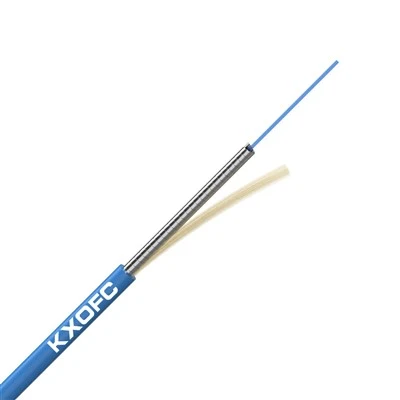
Now, around the optical fiber, there’s a coating. The coating is super important as it provides mechanical protection to the delicate fiber. It’s typically made of a soft, flexible material, like an acrylate polymer. This coating acts as a cushion, preventing the fiber from getting damaged during handling, installation, and normal use. Without this coating, the fiber could easily break or get scratched, which would disrupt the signal transmission.
But what makes these cables anti – rodent biting? That’s where the special layers come in.
One of the common materials used for anti – rodent protection is a metal armor. Stainless steel or aluminum is often used to create a protective shield around the fiber and its coating. The metal armor is tough and difficult for rodents to chew through. It’s like a suit of armor for the fiber cable. Rodents have sharp teeth, but when they try to gnaw on this metal layer, they quickly give up because it’s just too hard.
Another approach is to use chemical deterrents. Some anti – rodent biting fiber cables are treated with special chemicals that have a very unpleasant taste or smell for rodents. These chemicals are usually non – toxic to humans and the environment but are extremely effective in keeping rodents away. For example, capsaicin, which is the compound that makes chili peppers hot, can be used as a rodent deterrent. When a rodent takes a bite of the cable, the capsaicin irritates its mouth and taste buds, and it won’t come back for more.
There are also cables that use a composite material for anti – rodent protection. This composite might combine a layer of metal with a layer of a tough polymer. The polymer can be something like polyethylene or polypropylene. These polymers are strong and durable, and when combined with the metal layer, they create an even more effective barrier against rodent attacks.
The outer sheath of the cable is also important. It’s typically made of a weather – resistant and tough material, like polyethylene or polyvinyl chloride (PVC). The outer sheath not only protects the inner layers from environmental factors like moisture, sunlight, and temperature changes but also provides an additional layer of protection against physical damage, including from rodents.
Let me tell you a bit about why we focus so much on making these anti – rodent biting cables. Rodent damage to fiber cables is a real headache in many industries. In telecommunications, a single nibble from a rodent can disrupt phone lines, internet connections, and even television services for thousands of customers. In power plants and industrial facilities, cable damage can lead to equipment malfunctions and safety hazards.
We’ve spent a lot of time and effort in research and development to come up with the best materials and designs for our anti – rodent biting fiber cables. We test these cables in different environments, simulating real – world conditions to make sure they work as expected. We also keep an eye on the latest research in materials science and pest control to incorporate the newest and most effective technologies into our products.
So, if you’re in an area where rodent damage is a concern, whether it’s a rural area with lots of field mice or an urban environment with rats, our anti – rodent biting fiber cables are the solution you need. Not only do they protect your valuable fiber infrastructure from rodent attacks, but they also ensure a reliable and stable signal transmission.
Whether you’re a telecommunications provider looking to upgrade your network, an industrial facility manager in charge of maintaining your equipment’s connectivity, or a homeowner wanting a reliable internet connection, our cables are designed to meet your needs.
We offer a wide range of options, from different types of optical fibers (glass or plastic) to various anti – rodent protection methods. We can customize the cables based on your specific requirements, such as the length, the number of fibers, and the level of anti – rodent protection needed.
If you’re interested in learning more about our anti – rodent biting fiber cables or if you’re ready to place an order, don’t hesitate to get in touch. We’re more than happy to have a chat with you, answer any questions you might have, and help you find the perfect cable solution for your situation.
References:
- "Optical Fiber Communication Systems" by Govind P. Agrawal
- "The Handbook of Telecommunications Cable Engineering" by John E. Finn
Optical Fiber That’s all for today. I hope you found this blog informative. Talk to you soon!
Hangzhou Lin’an Kexin Optical Cable Co., Ltd.
As one of the most professional anti rodent biting fiber cable manufacturers and suppliers in China, we’re featured by quality products and good price. Please rest assured to wholesale discount anti rodent biting fiber cable made in China here and get pricelist from our factory. Customized orders are welcome.
Address: No. 28 Linglong Street,Lin’an Area, Hangzhou City, Zhejiang Province, China
E-mail: sales@kexincable.com
WebSite: https://www.kexincable.com/
