Hey everyone, and welcome back to the blog! If you’ve ever dug into industrial automation, you’ve probably stumbled on rack and pinion actuators—those workhorses that turn linear motion into rotary (or vice versa) like no other. But let’s be real, one question I get asked more than any other by engineers, plant managers, and even hobbyists is: What’s the speed of a rack and pinion actuator anyway? Today, I’m breaking this down straight, no stuffy jargon, just real talk from someone who’s been selling these bad boys for 8 years now. Rack And Pinion Actuator

First off, let’s get one thing out of the way: there’s no one-size-fits-all number here. If you’re looking for a single “speed rating,” I can give you a rough range, but the real answer depends on a ton of factors—and I’ve seen first-hand how getting this wrong can tank a project. Let’s start with the basics. A rack and pinion actuator works by having a straight gear (the rack) that slides back and forth, meshing with a round gear (the pinion) that spins. The speed of the whole thing ties directly to how fast that pinion turns, right? But wait—how you measure “speed” matters too. Are we talking linear speed (how fast the rack slides, in inches per second or mm/s) or rotary speed (how fast the output shaft spins, in RPM)? That’s a key distinction most new buyers mix up.
Let’s talk linear speed first, since that’s what most folks are referencing when they ask about “actuator speed.” For standard, off-the-shelf rack and pinion actuators (the ones we ship most every day), linear speeds typically land between 0.1 meters per second (that’s about 4 inches per second) and 3 m/s (roughly 118 inches per second). But hold on—before you think “wow, 118 inches a second is fast enough,” let me tell you: that’s only under perfect, low-load conditions. If you’re pushing a heavy gate, a valve with high friction, or a load that’s way too big for your actuator, you’re not hitting that speed. And if you’re running it at top speed 24/7, you’re going to wear out parts way sooner than expected.
Now, where does that speed come from? Let’s get into the variables, because this is where things get interesting. First is the pinion’s size. A bigger pinion means more torque for pushing heavy loads, but what does that do to speed? Let’s do a quick, dumbed-down math example: if your pinion has a circumference of 10 inches, one full spin of the pinion moves the rack 10 inches. If it spins at 10 RPM, that’s 100 inches per minute, or ~1.67 inches per second. If you swap that for a smaller pinion with a 5-inch circumference spinning at the same 10 RPM, you get 50 inches per minute, ~0.83 inches per second. Wait, that’s slower? Wait no—wait, flip that. If you want higher linear speed, you spin the pinion faster, or use a smaller pinion. But smaller pinions = less torque. So there’s a trade-off: speed vs. force. That’s the core equation of rack and pinion actuators, and it’s why I always push customers to tell me two things first: how much weight/force you need to move, and how fast you need it to move.
Next up is the power source. You can’t get high speed if you’re using a weak motor. Most rack and pinion actuators we sell run on pneumatic, electric, or hydraulic power. Pneumatic actuators are the most common for general use, and their speed depends on your air pressure and the size of your air lines. Crank up the air pressure from 80 PSI to 120 PSI, and you’ll get a faster cycle—but too much pressure can cause wear and tear, even damage seals. Electric actuators are more precise, and their speed is set by the motor’s RPM and the gear ratio we pair with it. Hydraulics are for super heavy loads, and they can hit faster speeds than pneumatics sometimes, but they’re messier and more expensive.
Another big one: load and inertia. This is the mistake I see all the time. A customer will come in, say “I need a rack and pinion for a 200-pound door, and I want it to open in 2 seconds,” so they grab the smallest, cheapest actuator they see. But a 200-pound door that’s tight in its track has more friction, so that small actuator can’t move it fast without straining. Inertia is even worse—if you’re moving something that’s got a lot of mass, you need to speed up and slow down gradually, because if you yank it, you’ll wear out the rack teeth or break the pinion. I had a customer last year working on a conveyor system for 500-pound metal parts. He ordered a standard actuator rated for 2 m/s, and when he fired it up, it only moved at 0.5 m/s. Why? He didn’t account for the part’s inertia and the friction from the conveyor rollers. We swapped him for a higher-torque, slightly slower actuator, and now he’s hitting 1.2 m/s, which is exactly what he needs, with no breakdowns.
Then there’s duty cycle. That’s just how often you’re running the actuator. If you’re opening and closing a valve every 10 minutes, a fast speed is fine. But if you’ve got a packaging line that cycles a rack 10 times a minute, all day every day, you can’t run it at top speed nonstop. Heat builds up in the motor, seals wear out faster, and the rack and pinion teeth get chipped. We always tell customers to adjust their speed based on duty cycle: high cycle = slightly slower, more durable speed; low cycle = faster is no problem.
Wait, let’s also touch on rotary speed, just so we cover that. If you’re using a rack and pinion to turn a shaft (like rotating a turntable), the output shaft’s RPM is calculated based on the linear speed of the rack and the pinion’s circumference. Using the earlier example: if your rack moves 10 inches per second, and the pinion has a 10-inch circumference, that’s 1 full spin every second, so 60 RPM. Easy, right? But again, that’s ideal.
Now, what about common applications and their typical speeds? Let’s get real, because this helps put it in perspective. For industrial ball valves, you’re looking at 0.1 to 0.5 m/s linear speed, which translates to a full valve open/close in 0.5 to 5 seconds. That’s perfect, because you don’t need to slam a valve open fast—you might cause water hammer or damage. For larger gate valves, maybe 0.3 to 1 m/s, slower because they’re heavy. For automated warehouse doors, those are faster—1 to 2.5 m/s, because you want them to open and close quickly for efficiency. For pick-and-place robotics, rack and pinion actuators there can hit up to 3 m/s, because they’re moving light parts, high speed is key.
But here’s the thing: no matter what your application, the best way to get the right speed is to work with someone who knows their stuff. As a rack and pinion actuator supplier, I don’t just sell you a part and send you on your way. I ask you: what’s the load? What’s the cycle time? What’s the power source you have? Do you need precision or just speed? Last month, a customer came to us panicking because his actuator was moving too slow for his assembly line. He’d bought a cheap one online that was rated for 1 m/s, but it was only hitting 0.3 m/s, and when he tried to crank the pressure, it was leaking. We swapped it for a mid-range electric rack and pinion with a custom gear ratio, and now he’s hitting 1.1 m/s, which is exactly what he needs, and it’s running for 10,000 cycles now with no issues.
I also want to bust a common myth here: faster isn’t always better. I had a customer a couple years ago who insisted on the fastest actuator possible for his loading dock door. He ordered one that was rated for 3 m/s, and the door would slam open so fast it would shake the whole dock, and within 3 months, the rack teeth were stripped because the constant high speed and impact wore them down. We adjusted the speed to 1.8 m/s, added a soft start feature, and now it’s been running for over a year without a single problem. Speed is a tool, not a bragging right.
If you’re in the market for a rack and pinion actuator and you’re stressing about getting the speed right, let me leave you with this: don’t just rely on the spec sheet. Most cheap actuators fudge their speed ratings to make them look better. The reputable ones (like the ones we carry) list their maximum speed under no-load conditions, which is almost never what you’re going to get in real life. So when you’re calculating, leave a 20-30% buffer between the speed you need and the rated maximum. That way, you’ve got room for load, friction, and wear over time.
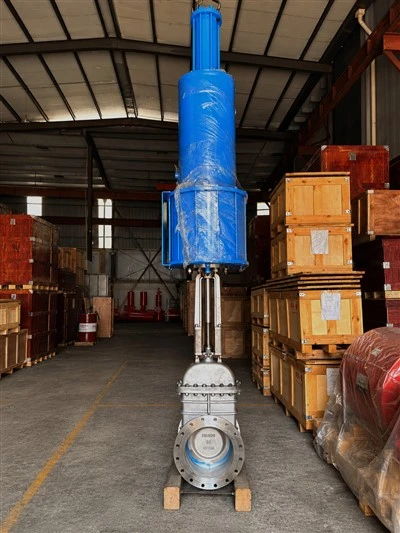
At the end of the day, the speed of a rack and pinion actuator isn’t a number you pull out of thin air—it’s a balance of your application’s needs, the parts you pair with it, and how you use it. If you’re tired of guessing, or you’ve had bad experiences with actuators that are too slow, too fast, or break too often, hit us up to chat through your project. We don’t do generic “one size fits all” here—we help you find the exact actuator with the right speed, torque, and durability for what you’re doing.
Pneumatic Valve Actuator Before I wrap up, quick reminder: don’t just chase speed. Take stock of your load, cycle, and power source, and talk to an expert who knows rack and pinion actuators inside and out. We’re always here to help, no pressure, just real advice from someone who’s been in this game for years.
References
- Rack and Pinion Actuator Design Guide, Industrial Automation Association, 2022.
- Pneumatic Actuator Speed Calculations, Fluid Power Journal, 2021.
- Load and Inertia Considerations for Linear Motion Systems, Motion Control Magazine, 2023.
- Commercial Rack and Pinion Actuator Performance Specifications, Global Industrial Components Association, 2022.
Zhejiang Bigtork Valve Automation Co., Ltd.
Zhejiang Bigtork Valve Automation Co., Ltd. is one of the leading rack and pinion actuator manufacturers and suppliers in China. We warmly welcome you to buy customized rack and pinion actuator at competitive price from our factory. Contact us for more details.
Address: 98 Yuanqu Avenue,Anfeng Industrial Zone,Oubei,Yongjia,Zhejiang,China.
E-mail: sales@bigtork.com
WebSite: https://www.bigtork.com/
